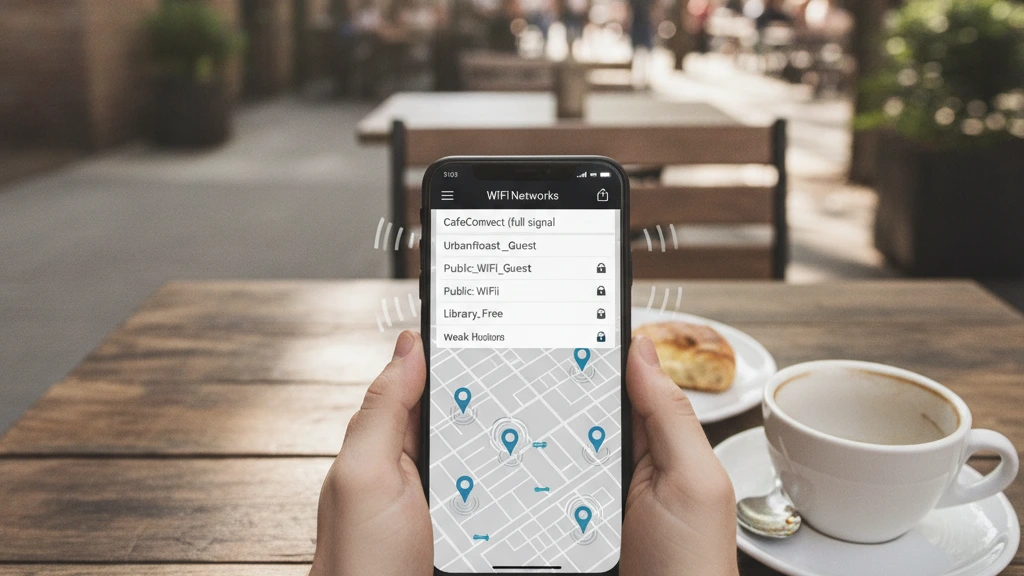
Best Apps to Find Free WiFi Near Me
You need internet but don’t want to drain your mobile data. Finding free WiFi near you shouldn’t take hours of searching. Modern apps solve this problem instantly—locating available networks, showing connection quality, and even rating speeds before you connect.
Nota: todos os links são para conteúdos dentro do nosso próprio site.
This guide reveals the best free WiFi finder apps that actually work, comparing their features, reliability, and real-world performance. Whether you’re traveling, commuting, or just exploring your neighborhood, you’ll discover tools that turn spotting WiFi networks from frustration into seconds of effort.
Stop wasting battery searching manually. The right app does it for you—mapping hotspots, verifying safety, and connecting faster than you’d expect.
WiFi Map: The Crowdsourced Leader
WiFi Map dominates the free WiFi finder space with over 220 million hotspots worldwide. Users contribute location data, passwords, and connection speed ratings continuously, creating a living database updated in real-time.
The app works offline. Download maps beforehand—essential when traveling internationally where data roaming costs devastate budgets. You’ll see cafes, libraries, restaurants, and public spaces marked with WiFi availability on your screen even without internet.
Speed ratings show connection quality before you commit. Red means slow (under 1 Mbps), yellow indicates moderate (1-5 Mbps), green signals strong (over 5 Mbps). This prevents wasting time on networks crawling at dialup speeds.
- Offline maps: works without data connection worldwide
- User ratings: speeds, passwords, recent availability
- Filter options: search by speed, outlet availability, seating
- Password sharing: community-verified network credentials
- Premium option: ad-free experience and advanced analytics
Download it free on WiFi Map’s official site or both app stores. The free version handles 90% of typical use cases—premium mainly removes ads.
OpenSignal: Coverage Beyond Just WiFi
OpenSignal specializes in comprehensive network coverage data. It shows free WiFi networks AND mobile signal strength simultaneously—perfect when you need to assess connectivity options at a glance.
The app continuously measures network speeds through user crowdsourcing. Over 5 million users contribute data monthly, meaning coverage maps update constantly with current conditions rather than outdated databases.
OpenSignal’s map visualization uses heat colors indicating signal quality zones. This helps you identify areas with strong signals before arriving, avoiding dead zones. The speed test feature measures actual performance—sometimes networks advertise speeds they don’t deliver in practice.
- Live maps: real-time signal strength visualization
- Speed testing: measure actual vs. advertised bandwidth
- Network comparison: see which providers perform best locally
- Detailed reports: identify coverage gaps and problem areas
- Free WiFi alerts: notifications when entering strong signal zones
Instabridge: Passwords Without Asking
Instabridge takes a different approach—it focuses on eliminating the password problem entirely. The app connects you to free WiFi networks that community members have already shared passwords for.
No need to ask the barista, check a receipt, or hunt for network details posted behind the counter. The app auto-fills credentials when connecting to recognized networks. This saves minutes during rushed moments—think airport layovers or hotel check-ins.
Security here matters. Instabridge encrypts stored passwords and only shares networks members voluntarily contributed. Your login credentials stay protected even when using public networks—the app creates a private tunnel between your device and verified hotspots.
One limitation: coverage depends entirely on community participation. Major chains like Starbucks or McDonald’s show robust data, but smaller local cafes might lack information. Build happens through usage—each connection strengthens the database.
Download on Instabridge’s platform for both iOS and Android, completely free with optional premium features for advanced filtering.
My WiFi: Simple Location-Based Search
My WiFi appeals to users wanting pure simplicity without feature overload. The interface contains three buttons: Find WiFi, Speed Test, and Report Problem. That’s it.
Tap “Find WiFi” and it shows nearby hotspots—distance, network name, signal strength, and password if available. No complicated maps, no unnecessary filters, no learning curve. The straightforward design makes it perfect for travelers unfamiliar with apps or older smartphone users.
Speed testing shows actual connection quality in seconds. Report functionality lets you flag networks that disappeared, moved, or no longer work—keeping the database accurate.
- Minimal interface: three main features, nothing confusing
- Quick access: find nearby WiFi in seconds
- Speed verification: built-in testing before connecting
- Error reporting: community quality control
- Free version: fully functional without premium upgrades
Comparison: Which App Fits Your Needs
Choosing between apps depends on your priorities. Need offline functionality? WiFi Map wins—its downloaded maps work globally without data. Traveling internationally? That offline feature becomes essential when roaming costs exceed $10 per megabyte.
Prefer automatic password filling? Instabridge handles that instantly, skipping password-hunting at every connection. Want comprehensive signal analysis including mobile networks? OpenSignal combines everything in one view.
Value simplicity over features? My WiFi delivers zero-friction searching. Advanced users appreciating detailed analytics? OpenSignal’s crowdsourced speed reports and heat maps provide that depth.
| Feature | WiFi Map | OpenSignal | Instabridge | My WiFi |
|---|---|---|---|---|
| Offline Maps | ✓ | ✗ | ✗ | ✗ |
| Auto Password Fill | ✓ | ✗ | ✓ | ✓ |
| Speed Testing | ✓ | ✓ | ✗ | ✓ |
| Mobile Signal Data | ✗ | ✓ | ✗ | ✗ |
| Community Ratings | ✓ | ✓ | ✓ | ✓ |
Security Considerations Before Connecting
Free public WiFi presents risks apps can’t completely eliminate. Network traffic travels unencrypted unless you use a VPN layer. Banking, email passwords, and sensitive information shouldn’t transmit over public networks without encryption.
Always enable VPN before accessing financial apps, email, or personal data on public hotspots. Most modern VPN apps integrate with WiFi finding tools—some automatically trigger when connecting to recognized public networks.
Never set your device to auto-connect to networks. Cybercriminals create fake hotspots with legitimate-sounding names. Manual selection prevents automatic connection to “StarBucks Free WiFi” (actually malicious mimicking the real Starbucks network).
Check the network name at the counter or website before connecting. Legitimate businesses confirm their correct network name—preventing confusion with spoofed duplicates created by attackers nearby.
Real-World Scenarios: Apps in Action
Imagine landing at an international airport with zero data. WiFi Map users download local maps beforehand, immediately finding verified hotspots throughout terminals. Offline capability becomes invaluable when roaming costs would damage your travel budget.
Picture yourself in an unfamiliar city, needing stable internet for a video call. OpenSignal shows signal heat maps indicating zones with consistently strong networks. You avoid scheduling important calls in known dead-zone restaurants or office areas.
Consider a coffee shop where the owner changed their network password weekly but never posts it. Instabridge users connect instantly using previously shared credentials, while others spend frustrating minutes asking staff. Those minutes add up across dozens of monthly connections.
A traveler with minimal smartphone experience needs quick WiFi nearby. My WiFi’s simple interface shows exactly what they need—distance, network name, signal strength—without overwhelming options or complex menus. Simplicity matters when technical confidence is low.
Emerging Trends: WiFi Discovery Evolving
WiFi finding apps continue advancing. AI-powered predictions now anticipate network availability based on historical data, time of day, and day of week. Weekend mornings show different network patterns than weekday evenings at the same locations.
Integration with smartwatches enables quick lookups without pulling out phones. Notifications alert users entering areas with strong available networks, preventing unnecessary manual searching.
Mesh networks expand coverage in developing regions—crowd-sourced community networks supplement traditional commercial WiFi. Apps increasingly recognize and map these community networks alongside traditional hotspots.
Privacy-first alternatives continue emerging for users concerned about crowdsourced data collection. These apps minimize personal information shared while still providing reliable hotspot locations through selective community participation.
Subscribe to app notifications and enable location services wisely—balance convenience against privacy. Most modern apps offer granular permission controls letting you share only non-identifying data while still receiving hotspot locations.
Choosing Your Perfect WiFi Finder
Test multiple apps because coverage varies by location. WiFi Map dominates major cities worldwide, but regional leaders might perform better locally. OpenSignal excels in areas with strong crowdsourced network testing communities.
Consider your primary use case. Frequent international traveler? Download WiFi Map today. Urban explorer prioritizing analytical data? OpenSignal offers depth. Convenience-focused user hating password hunting? Instabridge saves minutes daily.
Most successful users run two apps simultaneously—cross-checking recommendations when one shows incomplete data. Storage space costs nothing, but unreliable hotspot selection costs time and frustration.
Enable your chosen app’s notifications to catch nearby networks automatically. Background scanning consumes minimal battery on modern devices while alerting you to strong signals entering your area.
Update apps regularly—developers continuously improve location accuracy, expand coverage databases, and patch security vulnerabilities. Outdated versions might miss recently added hotspots or lack security improvements protecting your connection quality.